Introducing a Bottle to Your Breastfed Baby
It seems like everyone has an opinion on when, why, and how to introduce a bottle to your breastfed baby and a horror story to share on their baby refusing to take the bottle or breast because of introducing the bottle too early or too late.
The good news is, introducing a bottle does not need to threaten your breastfeeding relationship and it is absolutely possible to have a harmonious feeding relationship with both breast and bottle.
Timing
If possible, 3-6 weeks is the best time to introduce a bottle to focus on getting breastfeeding started. The main reason for this is because if you are bottle feeding and your goal is to have a full supply, you will also need to introduce pumping so that your body maintains supply with regular milk removal. Nursing, bottle feeding, and pumping all within the first few weeks can feel overwhelming and be a significant learning curve to learn all three feeding methods, so if possible it is easier to wait a few weeks and just focus on establishing the nursing relationship. However, if your baby is not gaining adequate weight or has other complications like jaundice or hypoglycemia and is requiring supplementation, a bottle is often the easiest way to do this. If early supplementation is needed for a short period, syringes, cups, and spoons may be preferred but if a parent prefers a bottle due to convenience, frequency, and/or length of supplementation needed, introducing bottles early does not mean breastfeeding will be sabotaged!
Choosing a Bottle
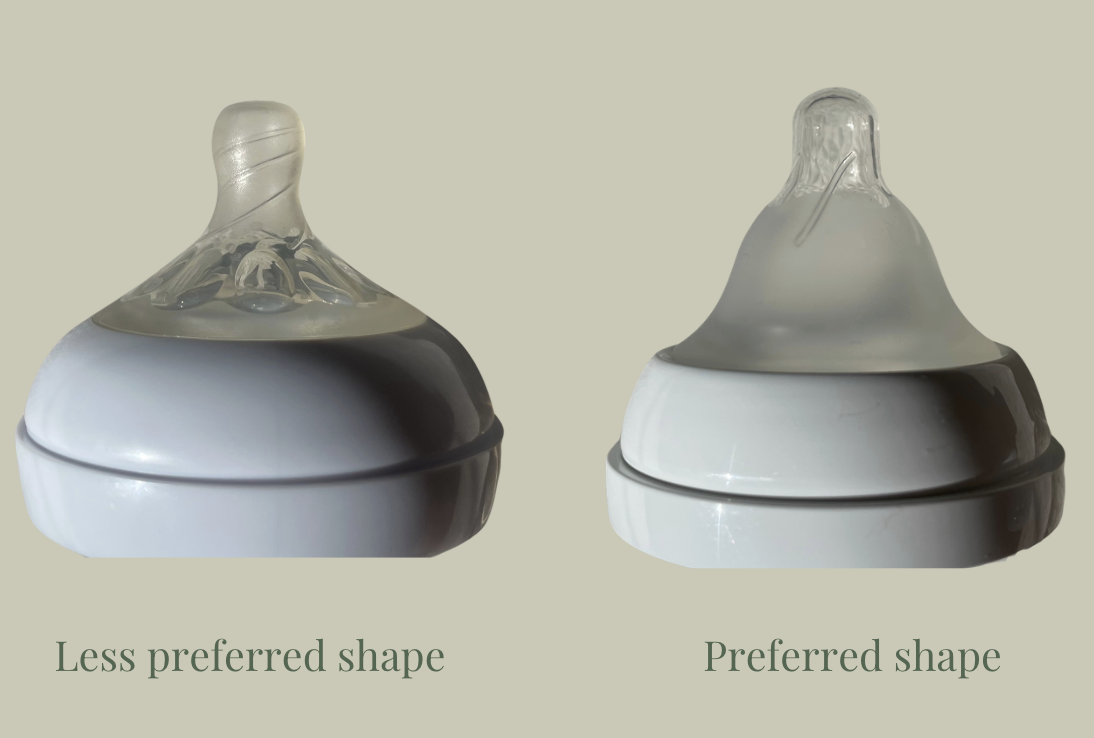
In general, the best bottles for your breastfed baby will have a gradual sloped nipple that encourages a wide latch and a slow flow. I recommend the Pigeon with SS flow nipple (glass option here), Nuk Perfect Match, Lansinoh Mama (warning - this is a fast flow and better for older babies) and Evenflo Balance (glass option here). If using Dr. Brown’s, try preemie nipple. You will know the flow is appropriate when there is no leaking, choking, clicking, or stress cues (flailing arms, furrowed brow, arching away, etc.) and your baby finishes each ounce in about 5-10 minutes.
Technique
If you are introducing the bottle to your baby who is used to nursing at the breast, keep in mind that bottle feeding is a skill and it may take some time for baby to adjust. You can begin to practice with bottles once a day, when your baby is calm and not too tired or hungry. These can be snack amounts of 1-2 oz or full feeds of 3-5oz. If not nursing, most babies between 1-6 months old will drink 1-1.5 oz for every hour since their last feed (ex. 3-4 oz every 3 hours). The goal for these practice sessions is to build positive associations with bottle feeding and learn and maintain the skill of removing milk from a bottle.
You may have come across the term “paced bottle feeding” as a method to feed the breastfed baby, where you keep the bottle horizontal and take frequent breaks. This method originated in the NICU to help babies manage a feed without stress. However, for healthy full-term babies, they should be able to regulate their own intake. Instead, I recommend a “responsive feeding” approach:
Hold the bottle angled down near the baby’s nose with gentle chin pressure with the bottle's collar. Wait for your baby to open wide before inserting the nipple, aiming for the top back of the baby's mouth.
Once baby is latched onto the nipple, continue angling the bottle down (no milk flowing yet) and allow them to suck for ~30 seconds before tilting the bottle. This mimics the "letdown reflex" at the breast, where baby has to suck for a period of time before the faster flow of milk begins.
Throughout the feed, lower the bottle when baby stops sucking and lift it again when they start. If your baby looks stressed (flailing arms, wide eyes, tense hands), lower the bottle to pause the flow of milk. If infant is upset or crying, try again another day to maintain positive associations with the bottle. Your baby may do better with a different bottle shape or flow rate, so reach out to discuss what other options are available.
Integrating Bottle and Breast
Once you have introduced a bottle and baby has grown accustomed to it, it can be easy to forget to practice especially if the parent has a longer parental leave and it is more convenient to nurse. It is important to practice at least every other day so that baby does not forget how to take a bottle - this can occur especially after 8-12 weeks when baby’s suck reflex integrates and baby sucks “by choice” based on their learned skills, rather than as a reflex. Bottle practice does not need to be a full feed and can be a snack of 1-2 oz that the parent hand expresses directly into the bottle to avoid the washing of pump parts.
More Information
More questions or need 1-1 support? Schedule a virtual or in person consult!